

Pakistan–Saudi Strategic Reset
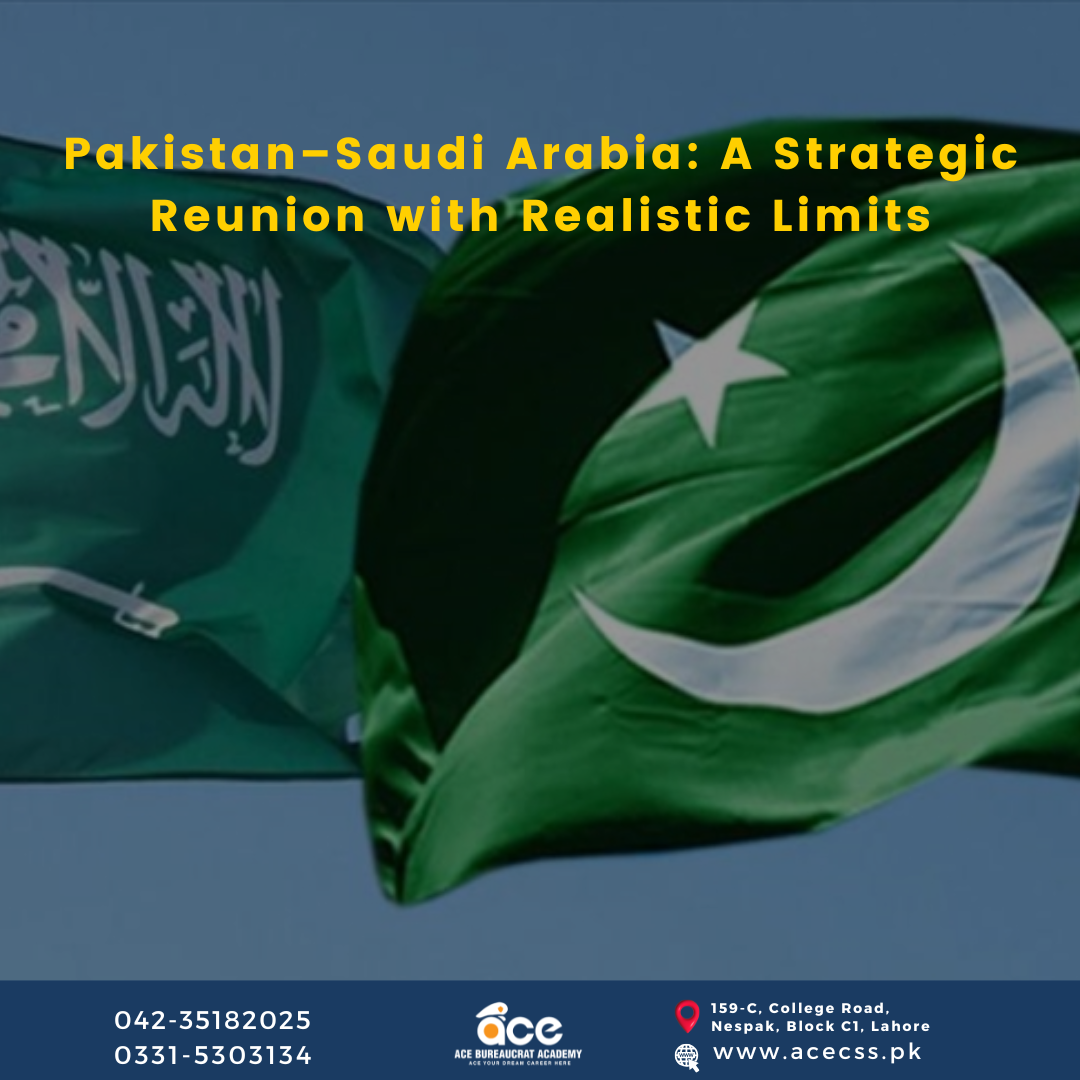
Pakistan- Saudi Strategic Reset: They recently rebuilt their close relationship by signing an important defence agreement. This comes after more than six years of tension and shifting alliances. During that time, Pakistan moved closer to a group of countries including Iran, Turkiye, and Malaysia—something Crown Prince Mohammed bin Salman (MBS) didn’t like. There were also rumours of personal tensions between MBS and Pakistan’s former prime minister, Imran Khan, which made things worse.
Problems had started even earlier when Pakistan refused to send troops to help Saudi Arabia in the Yemen war, despite receiving a warm welcome from King Salman. MBS had also planned to create an “Islamic NATO,” but that idea failed. As a result, Saudi Arabia began building closer ties with India and continued depending on the United States for military support. In 2023, Saudi Arabia, the UAE, and the US announced the India-Middle East Economic Corridor—a trade route that left Pakistan out, as it was already tied to China’s Belt and Road Initiative through the China-Pakistan Economic Corridor (CPEC).
During this time, both countries looked for new friends. Pakistan tried to improve relations with Turkiye, Azerbaijan, and countries in Central Asia. Saudi Arabia, on the other hand, improved its ties with Iran, Turkiye, and Russia. Both nations were testing their influence and adjusting to a changing world.
Mutual Defence Understanding
Now, they have signed a new defence agreement. It’s not the first of its kind, but one part stands out: it says that if either country is attacked, the other will treat it as an attack on itself. This sounds similar to NATO’s rule for its members. In Pakistan, people see this as a warning to India. In the Middle East, others see it as a move against threats like the war in Yemen or possible attacks from Israel.
Even so, it’s unlikely that Saudi Arabia will change its close relationship with India. For years, both countries have built strong trade and political ties. Saudi Arabia’s Vision 2030 plan depends on economic partnerships, and India plays an important role in that. If there’s ever a conflict between India and Pakistan, Saudi Arabia is more likely to offer to mediate, not take sides.
No Islamic NATO
Both countries have learned lessons from the past. Saudi Arabia now sees that its relationship with Pakistan should be about more than just military help or financial aid. It should include training, joint defence projects, and long-term cooperation. Pakistan also needs to understand that real strength doesn’t come from military power alone. A strong economy and unity at home are just as important.
Some people hope this deal will lead to a united Islamic military force, but that’s unlikely. Leaders in Saudi Arabia and other Gulf countries are not interested in such ideas. These dreams are often pushed by Iran, which wants to lead the Muslim world, or by radicals and hardliners in countries like Pakistan. In reality, Muslim countries often compete with each other, and a united alliance is not realistic.
Building True Partnership
Still, this new agreement can help Pakistan in real ways—especially in terms of economic and defence support. But Pakistan must stop depending on Saudi Arabia only during times of financial crisis. A strong partnership should be based on shared interests, not just one country asking for help. Now both sides have a chance to build a better, more equal relationship for the future.
Published in Dawn, 21st September 2025

It’s a very informative.